Table of Contents
~~DISCUSSION:closed~~
Game Review Template V4.0 (2014)
Note: This template is copyright K.Becker and may not be used without her written permission.

| Game: | link to game | Audience: | ?? | |
|---|---|---|---|---|
| Publisher: | link to publisher | Subject: | ?? | |
| Developer: | link to developer | Grade(s): | ?? | |
| Release: | ?? | Platform: | ?? | |
| Genre: | ?? | Cost: | ?? | |
| Perspective: | ?? | |||
Description
describe the game here
Source: Game Site
Screenshots
Summary
Provide a summary of the review and the overall rating, out of 100.
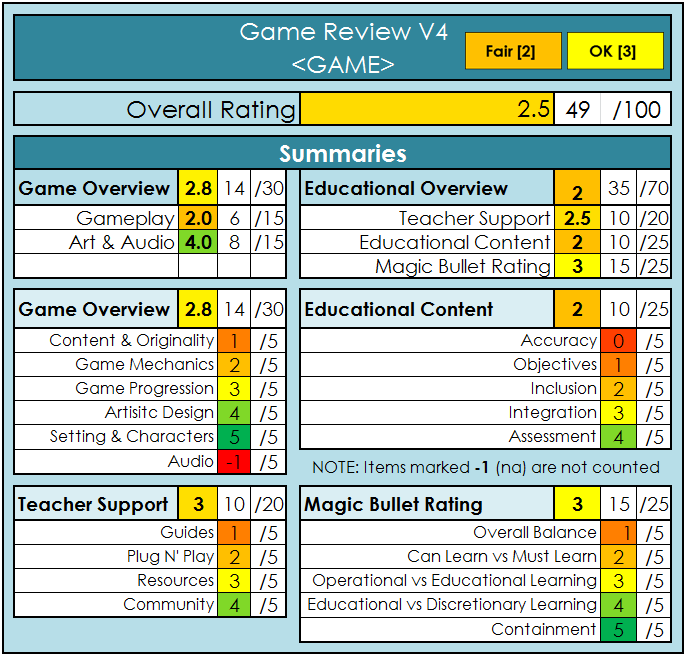 explain
Detailed Review
Gameplay, Art & Audio
 How is it as a game? Is it fun? Is it Interesting?
How does it measure up esthetically? This includes visual and auditory components.
|
Content & Originality Are the game elements well developed and appropriate for the game? Does it show original thought? Does it follow accepted norms for the genre? ~OR~ does it have new take on known genre? 1) |
|

|
Game Mechanics. What can you do in the game? Are the controls logical and easy to use? Does each 'level' fit the overall style of the game? |
|
|
Game Progression. The transitions between levels (which need not be traditional levels) go from simple to challenging and are smooth and appropriate for the game. |
|
|
Is it overall Visually Attractive? Does it make me want to try the game? Does it seem to be appropriate for the game? |
|
|
Does it seem to be appropriate for the game? Is it: Appealing. Distinctive. Sufficient variety. Original or appropriate. |
|
|
Does it seem to be appropriate for the game? Is it: Appealing. Distinctive. Sufficient variety. Original composition or appropriately credited |
|
Teacher Support
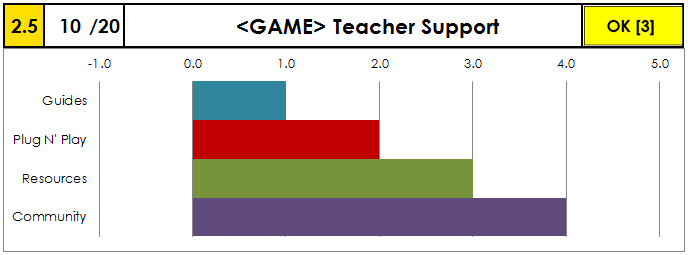 Is there adequate teacher support to make viable for use in a formal setting?
|
Teacher's guide exists and is easy to find. It is clear how to use this game. Includes: Description of game play.Content description (documentation) is well organized. I can see how the game will play. Any required special permissions/skills to install or run are clearly identified. Installation and execution processes are clearly identified and easy to read and follow. |
|
|
Plug and Play includes lesson plans with thorough instructions for using it in the classroom (or other target environment). Will not require large time investment to make it “teacher-ready” |
|
|
Supplementary resources for teachers (background, how to use, where to get help) exist, and are both complete and readable. |
|
|
A community exists where teachers can go for help, support, to share. It is clearly identified and easy to find. |
|
Educational Content
 How well does it appear to deliver on its educational objectives?
(This is is an analysis performed without user studies, so it is not possible to verify this here.)
How well does it appear to deliver on its educational objectives?
(This is is an analysis performed without user studies, so it is not possible to verify this here.)
|
Accuracy Does the game contain accurate information? 2) |
|
|
Objectives Does it appear to meet the educational objectives? 3) |
|
|
Inclusion Does required learning in the game include the educational objectives? 4) |
|
|
Integration Is required learning integrated into the game? 5) |
|
|
Assessment Is scoring in the game related to the learning content? |
|
Where possible, links to studies using this game in educational settings are listed and studies cited.
Magic Bullet Assessment
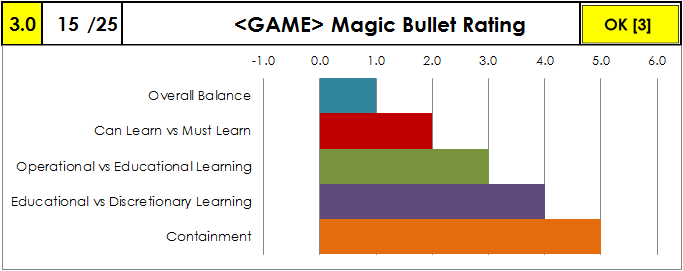 How does it fare when viewed through the lens of the Magic Bullet Model?
This section examines the game through the lens of the Magic Bullet model to see how well the various learning elements are balanced. This looks at both the overall balance and the educational components
|
|
Bullet Class
For a more detailed explanation, see: Magic Bullet Assessment |

In each of these categories the rating is determined by how well the balance of the elements fits the type of game it is, its intended use and audience.
|
Overall Balance Is the relationship between the 4 main categories appropriate for this game given its intended use? |
|
|
Can vs. Must Is it possible to get through the game without learning anything (i.e. without meeting any of the educational objectives)? |
|
|
Operational vs Educational Is the required operational learning appropriate for the game's intended purpose? |
|
|
Educational vs Discretionary Is there an appropriate balance of learning and fun? |
|
|
Containment Is the game (including support materials) sufficiently self-contained to justify its use in the given context? |
|
General explanation goes here.
Instructional Strategies
Not Scored
What instructional strategies does it use?
Presumably, the primary instructional strategy is Concept Formation through Discovery
There's a great list <HERE> (Kelly Jo Rowan) and <HERE> (Saskatoon Public Schools)
Theoretical Underpinnings
Not Scored
What theories, models, or principles were used in the design of this game?
Constructivist, and Inquiry Based Learning Theories
This particular game was analyzed as part of a course requirement. The theories for the week included:
- Assimilation and Accommodation (Piaget)
- Developmental Learning (Piaget)
- Zone of Proximal Development(Vygotsky)
- Behaviorism (Skinner)
- Facts, Concepts, and Schemas
- Constructivism (Papert)
It's possible to superimpose virtually every one of these theories onto the game, but at some point it becomes very much like Astrology: people can always find aspects that apply to them which gives the appearance of validation. However, if we take a stricter view, then we get this:
- Assimilation and Accommodation (Piaget)
- This assumes at least some prior concepts or theories on the part of the player.
- If the player already knows about osmosis, then this theory may apply in that players may use their experiences in the game to adapt their existing notions about how osmosis works.
- On the other hand, if they don't already know about the subject matter it is quite possible that playing this game will not help, at least not without considerable additional outside (read: teacher or other facilitator) help.
- Developmental Learning (Piaget)
- This game is claimed to be targeted at all ages, so differences in the player's stage of developmental learning should not play a role. That having been said, it seems quite clear that this game will work better with some age groups than others. I would say the ideal age group for this game would be middle school (G4-8)
- Zone of Proximal Development(Vygotsky)
- This theory predicts that optimal learning happens when the difficulty of the activity is just on the edge of the player's ability, often requiring the help of others in order for the player to succeed. As this is not particularly a social game and there is not readily available community of learners, this theory doesn't really apply.
- Again, just as was said regaring Assimilation and Accomodation, WITH help, this theory might apply, but without the help of someone who actually knows the subject matter and who can accurately explain what's going on in the game, ZPT is not at play here.
- Behaviorism (Skinner)
- While this theory is often maligned as being out of date, there remain some key applications where learning in this fashion is useful. This isn't one of them. The notion of shaping behaviour through rewards and/or punishment does not really apply here.
- Facts, Concepts, and Schemas
- It may well be that the designers were counting on the player's development of various schema in order to pick up the necessary concepts involved in the process of osmosis. I am not convinced that they succeeded. There is insufficient scaffolding in this game to facilitate the necessary concept building. There is a very short page explaining the process of osmosis, which I find somewhat confusing. Some sort of teacher's guide could go a long way towards making this game viable as a learning object.
- Constructivism (Papert)
- This is likely the primary theory that was employed in the development of this game. The main idea was to permit players to explore and play around with Osy, and through discovery, to figure out the concepts - thus constructing understandings for themselves. As in with the previous theory, I am unconvinced that the designers succeeded.
I'm building a list of theories and principles here. (At the time of this writing, it is still empty. Sorry.)